

NxtEdge Resource Center
Control Hospitality Operations From Purchasing To Accounting In One Connected Platform
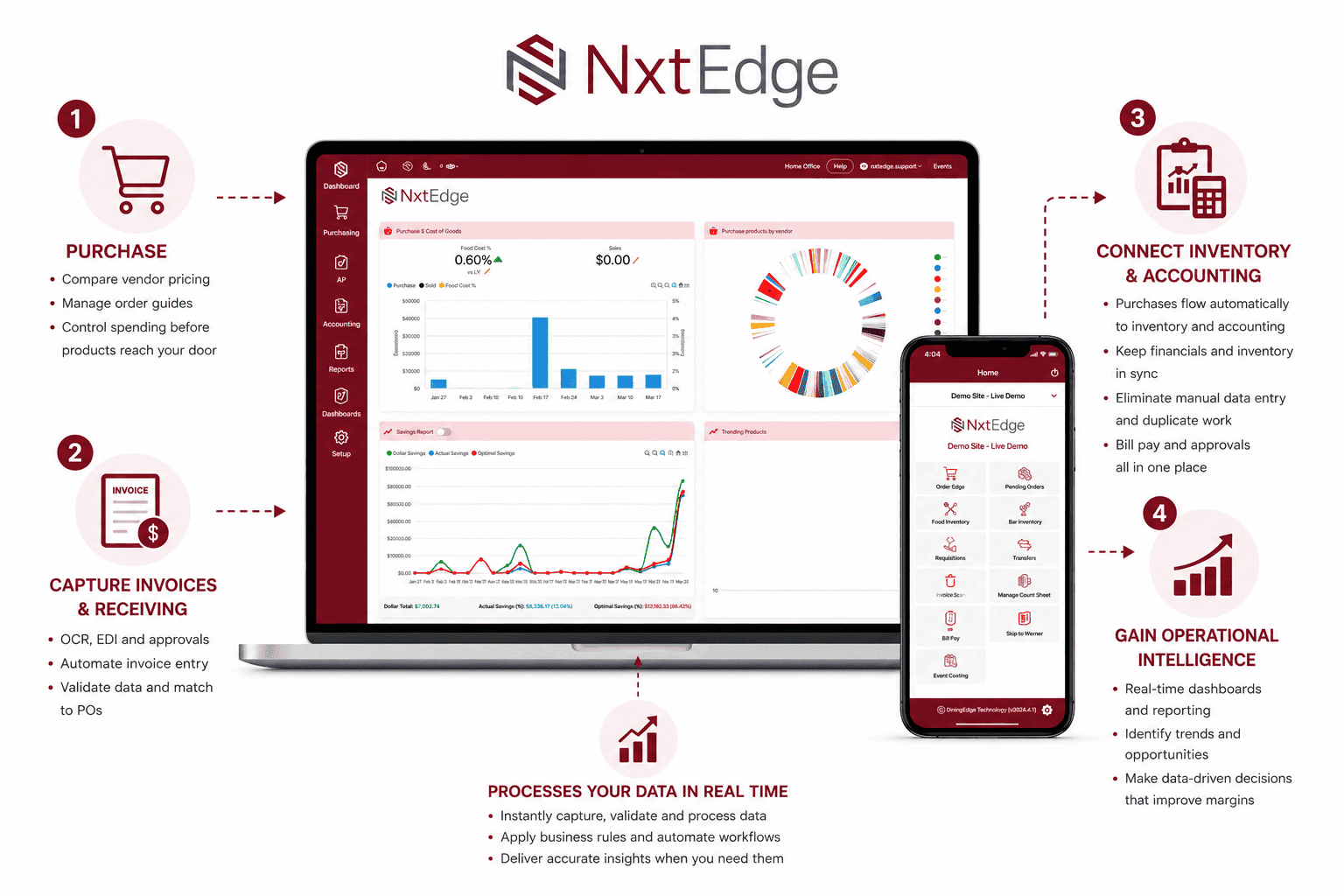
Hotels, resorts, and casinos operate some of the most complex food and beverage environments in hospitality. Multiple restaurants, bars, banquets, room service, retail outlets, employee dining facilities, and receiving locations all generate purchasing activity, inventory movement, invoices, approvals, and financial transactions. NxtEdge connects operational workflows and accounting processes into one platform, providing visibility across the entire property. Manage purchasing, receiving, inventory, invoice automation, approvals, bill pay, accounting integration, banquet costing, and property-wide reporting across every department, outlet, and location.
- Flexible location configuration built around your property
- Purchasing, receiving, inventory & transfers in one platform
- Invoice automation, AP approval & bill pay for the entire resort
- Connect operations directly to accounting systems
The Complete Guide to Hotel, Resort & Casino Cost Control Software
Controlling costs across a hotel, resort, or casino is significantly more complex than managing a standalone restaurant.
A single property may include:
- Fine dining restaurants
- Casual dining outlets
- Pool bars
- Coffee shops
- Banquet operations
- Room service
- Employee dining
- Retail stores
- Golf operations
- Spa facilities
- Nightclubs
- Event venues
Each department may purchase independently. Some products may flow through centralized receiving. Others may be delivered directly to individual outlets. Inventory may move between departments multiple times before reaching the guest. Invoices arrive from hundreds of vendors, and accounting teams must allocate expenses properly while maintaining visibility across the property.
Traditional ERP systems provide financial reporting, but they rarely manage hospitality operations effectively. Operational systems often solve individual problems but fail to connect the entire workflow. The result is fragmented information, duplicate data entry, limited visibility, and significant administrative effort.
Modern hospitality organizations require a different approach. They need one platform capable of connecting purchasing, receiving, inventory, transfers, invoice automation, approvals, bill pay, accounting integration, recipe costing, banquet costing, and reporting.
This guide explores how hotels, resorts, and casinos can improve operational visibility, strengthen financial controls, and create a connected cost control environment throughout the property.
Hospitality Operations Have Outgrown Traditional ERP Systems
Most ERP systems were built for accounting.
They were designed to manage:
- General ledgers
- Accounts payable
- Financial reporting
- Budgeting
- Fixed assets
These functions remain important. However, hospitality operations require far more than financial reporting. They require operational visibility. The challenge is that operational activities occur long before accounting ever sees a transaction.
The operational lifecycle before accounting sees a dollar:
- 1A purchasing manager places an order.
- 2A receiving team accepts product.
- 3Inventory is distributed throughout the property.
- 4Products are consumed through restaurants, bars, room service, or banquets.
- 5Invoices arrive from vendors.
- 6Managers approve expenditures.
- 7Payments are issued.
- 8Only then does accounting receive the financial impact.
Most ERP systems tell operators what happened financially. Very few help control what happens operationally. This creates a gap between operations and accounting.
A gap that often leads to:
- Duplicate data entry
- Inventory inaccuracies
- Delayed reporting
- Poor purchasing visibility
- Vendor pricing challenges
- Weak approval controls
- Limited department accountability
Hotels and resorts have attempted to solve these problems through multiple software systems — one system for inventory, one for purchasing, one for AP, one for reporting, and one for accounting. The result is often even more complexity. Information becomes fragmented across departments, and leadership spends time collecting information rather than using it.
The organizations achieving the greatest success today are those connecting operational workflows and financial systems into one complete process.
The future of hospitality cost control
It is not another accounting platform. It is operational visibility connected directly to accounting.
Configure Operations Around Your Property, Not Around Your Software
Every hotel, resort, and casino operates differently.
Some organizations use centralized receiving. Others allow departments to receive products directly. Some maintain central warehouses. Others operate entirely through outlet-level inventory. Most properties use a combination of both.
The problem with many hospitality systems is that they force organizations into a predefined workflow. Real-world hospitality operations are rarely that simple. NxtEdge was designed around flexibility. Organizations can configure:
Purchasing Locations
- Restaurants
- Bars
- Banquets
- Room service
- Retail
- Golf operations
- Spa facilities
- Employee dining
Receiving Locations
- Single receiving dock
- Multiple receiving docks
- Department receiving
- Outlet receiving
- Vendor direct delivery
Inventory Locations
- Central warehouse
- Restaurant storage
- Bar storage
- Banquet storage
- Retail inventory
- Employee dining
- Pool operations
Transfer Locations
Move products between departments while maintaining accountability and visibility.
Requisition Locations
Allow departments to request inventory from centralized locations while maintaining complete documentation.
Accounting Locations
Allocate expenses according to the property's financial structure while maintaining operational visibility.
Flexible Hospitality Operations
One property may operate with a fully centralized flow, while another receives directly at each outlet. Most resorts operate somewhere in between.
Centralized flow
Distributor → Main Receiving → Central Inventory → Restaurant
Outlet-direct flow
Distributor → Pool Bar • Distributor → Coffee Shop • Distributor → Banquet Kitchen
NxtEdge allows properties to configure workflows around operational requirements rather than software limitations. This flexibility is one of the primary reasons hotels, resorts, and casinos choose NxtEdge.
Your software should adapt to your operation
Because hospitality operations are complex. Not the other way around.
Chapter 1
Purchasing & Vendor Price Comparison
Every hospitality operation purchases products. The most successful hospitality operations manage purchasing strategically — and there is a significant difference.
Many hotels, resorts, and casinos spend substantial time reviewing food costs, inventory reports, and financial statements while spending relatively little time managing the purchasing decisions that ultimately drive those results. By the time a cost increase appears on a financial report, the purchasing decision has already been made. The invoice has already arrived. The product has already been consumed. The opportunity to influence profitability has passed.
The most effective cost control programs begin long before inventory is counted or invoices are approved. They begin with purchasing. NxtEdge helps hospitality organizations gain visibility into purchasing activity across the entire property while creating accountability, consistency, and operational control.
Why Purchasing Is the Foundation of Cost Control
Every purchasing decision affects:
- Inventory value
- Food cost
- Beverage cost
- Menu profitability
- Cash flow
- Vendor spending
- Department performance
- Overall profitability
When purchasing decisions occur independently across multiple outlets, departments, and managers, organizations often lose visibility into spending patterns and pricing opportunities. A single resort may run fine dining purchasing, banquet purchasing, pool operations purchasing, room service purchasing, retail purchasing, and employee dining purchasing — and without visibility across departments, it becomes difficult to understand total spending and purchasing behavior.
NxtEdge helps consolidate this information into one platform, creating a complete view of purchasing activity across the property.
Property-Wide Vendor Price Comparison
One of the largest opportunities within hospitality purchasing is vendor price comparison. Many organizations purchase similar products from multiple distributors, yet comparing pricing is often difficult. Purchasing teams must navigate vendor portals, distributor websites, spreadsheets, historical invoices, and product lists — a process that is time-consuming and often inconsistent.
NxtEdge allows operators to compare pricing across vendors before placing orders. This creates visibility into:
- Current costs
- Vendor alternatives
- Purchasing opportunities
- Historical pricing trends
- Product substitutions
Rather than relying solely on vendor relationships or historical purchasing habits, organizations gain information that supports better purchasing decisions.
Centralized Procurement With Local Flexibility
Many resorts struggle to balance centralized purchasing control with operational flexibility. Corporate leadership may want visibility and consistency. Outlet managers may require operational independence. NxtEdge supports both — organizations can establish centralized purchasing standards while allowing departments to maintain operational flexibility where appropriate. This creates:
- Better visibility
- Improved compliance
- Reduced purchasing variance
- Stronger vendor management
- Department accountability
The result is a purchasing process that supports organizational goals without limiting operational effectiveness.
Approved Products & Vendor Compliance
One of the most common purchasing challenges in hospitality is product inconsistency. Different managers may purchase different products. Substitutions may occur without review. Departments may use non-approved vendors. Over time, this creates:
- Cost variability
- Inventory challenges
- Recipe inconsistencies
- Reporting issues
NxtEdge helps organizations establish approved purchasing programs while maintaining visibility into purchasing activity. This improves consistency throughout the operation while supporting cost control initiatives.
Flexible Purchasing Structures
Every property operates differently. Some organizations purchase through a centralized procurement team. Others allow departments to place orders independently. Many properties use a hybrid approach. NxtEdge supports:
- Central purchasing — corporate or property-wide purchasing teams maintain oversight
- Department purchasing — individual outlets manage purchasing activity
- Hybrid purchasing — centralized oversight combined with local purchasing flexibility
This allows organizations to configure purchasing workflows based on operational requirements rather than software limitations.
Purchasing Visibility Across the Entire Resort
One of the greatest benefits of a connected purchasing platform is visibility. Leadership can understand:
- Total vendor spend
- Department spend
- Category spend
- Purchasing trends
- Vendor performance
- Cost changes
This information helps organizations identify opportunities that may otherwise remain hidden. Rather than waiting for month-end reports, leadership gains operational visibility in real time.
Inventory-Aware Purchasing
Purchasing decisions should not occur independently of inventory, yet this happens frequently. Departments order products without knowing current inventory levels. Inventory exists elsewhere on the property but remains unused. Excess inventory accumulates, waste increases, and cash becomes tied up in unnecessary stock.
NxtEdge helps connect purchasing and inventory management, allowing teams to make more informed purchasing decisions based on actual inventory information. The result is improved inventory utilization and stronger cost control.
Purchasing for Multi-Outlet Properties
Hotels, resorts, and casinos often manage purchasing across restaurants, bars, banquets, room service, pool operations, retail stores, employee dining, golf operations, and spa facilities. Each area may operate independently while still contributing to overall property spending. NxtEdge provides visibility at both the outlet level and the property level, allowing leadership to understand operational performance while maintaining departmental accountability.
Beyond Traditional Procurement Software
Many procurement platforms focus exclusively on purchasing. The challenge is that purchasing does not operate in isolation — it affects invoices, inventory, transfers, recipes, banquets, accounting, and reporting. NxtEdge connects purchasing to the rest of the hospitality operation. Rather than creating another standalone system, it becomes part of a larger cost control platform that supports operational and financial visibility across the property.
The Result
When purchasing becomes visible, controlled, and connected, purchasing stops being a transactional activity. It becomes a strategic advantage.
Benefits
- Compare vendor pricing across distributors before placing orders
- Consolidate property-wide purchasing into one complete view
- Balance centralized control with outlet-level flexibility
- Enforce approved products and vendor compliance
- Connect purchasing to live inventory to reduce waste
- See vendor, department, and category spend in real time
See how hotels, resorts, and casinos gain visibility into purchasing activity, improve vendor management, and control costs before products ever reach the property.
Chapter 2
Invoice Automation & Property-Wide Invoice Processing
For most hotels, resorts, and casinos, invoice processing remains one of the most labor-intensive administrative functions within the organization. Every day, invoices arrive from food vendors, beverage vendors, retail suppliers, housekeeping suppliers, maintenance vendors, golf vendors, spa vendors, uniform suppliers, equipment vendors, and service providers.
A large property may process hundreds or even thousands of invoices each month. Many organizations still rely on manual processes to review, code, route, approve, and enter invoice information into accounting systems. The result is often:
- Duplicate data entry
- Coding errors
- Approval delays
- Limited visibility
- Increased labor costs
- Slower financial reporting
Invoice automation helps eliminate these inefficiencies while creating a stronger operational and financial workflow. NxtEdge helps properties transform invoices into usable operational and accounting data without relying on manual entry.
Why Invoice Automation Matters
Invoices represent much more than accounts payable transactions — they contain valuable operational information. Every invoice reveals:
- Vendor spending
- Product costs
- Department expenses
- Purchasing activity
- Cost increases
- Contract compliance
- Inventory value changes
Unfortunately, when invoices remain trapped inside PDFs, email inboxes, filing cabinets, or disconnected accounting systems, much of this information is never fully utilized. Invoice automation transforms invoices into operational intelligence — rather than simply processing paperwork, organizations gain visibility into spending activity across the entire property.
Property-Wide Invoice Management
Unlike standalone restaurants, hotels and resorts often manage invoices across dozens of departments — Food & Beverage (restaurants, bars, banquets, room service, pool operations, employee dining), Guest Services (housekeeping, front office, guest amenities, laundry), Property Operations (maintenance, engineering, grounds, facilities), and Revenue Centers (golf, spa, retail, entertainment, casino operations).
NxtEdge provides one centralized platform for managing invoices across the entire organization while maintaining department-level visibility and accountability.
Multiple Invoice Intake Methods
Vendors deliver invoices in many different ways — some provide electronic files, others send PDFs, some use EDI, and others rely on email. Hospitality organizations need flexibility. NxtEdge supports multiple invoice intake methods including:
- Email processing
- PDF upload
- OCR processing
- EDI integrations
- Vendor integrations
- Mobile capture
- Automated import workflows
This flexibility helps organizations standardize invoice processing regardless of vendor capabilities.
OCR, AI & Human Validation
Accurate invoice processing requires more than optical character recognition alone. Hospitality invoices often contain complex product descriptions, variable pack sizes, catch-weight products, department allocations, special charges, and vendor-specific formats.
NxtEdge combines OCR technology, AI-assisted processing, and validation workflows to improve invoice accuracy. Rather than capturing only invoice totals, the system reads detailed line-item information that can support operational and accounting workflows throughout the organization.
Line-Item Visibility
Many AP systems focus only on header-level invoice information. Hospitality organizations need more detail. NxtEdge captures information such as:
- Product descriptions
- Quantities
- Unit costs
- Extended costs
- Vendor information
- Invoice dates
- Invoice numbers
- Department allocations
This visibility supports purchasing analysis, inventory valuation, vendor management, and reporting.
Automated Coding & Department Allocation
One of the most time-consuming aspects of invoice processing is coding. Large properties often allocate expenses across departments, outlets, cost centers, locations, and general ledger accounts. Manual coding increases labor requirements and introduces inconsistencies.
NxtEdge supports automated coding workflows that help organizations improve consistency while reducing administrative effort. This allows accounting teams to focus on review and analysis rather than repetitive data entry.
Invoice Processing Beyond Food & Beverage
Many hospitality solutions focus exclusively on food and beverage invoices. Hotels, resorts, and casinos require a broader approach. NxtEdge supports invoices across the entire property — food & beverage, retail, housekeeping, maintenance, engineering, spa operations, golf operations, and administrative departments — creating a unified invoice workflow across the organization rather than separate processes for different departments.
Updating Inventory & Operational Data
Invoices should not exist in isolation — they should influence operational systems. As invoices are processed, NxtEdge can help update product costs, inventory values, purchasing data, recipe costs, and reporting information, creating a more connected environment where financial transactions support operational visibility.
Supporting Approval Workflows
Invoice automation is often the first step in a larger accounts payable process. Once invoices are captured and coded, they may require department approval, manager approval, controller approval, and executive approval. Because NxtEdge connects invoice automation and approval workflows, invoices move seamlessly through the review process while maintaining complete visibility — reducing delays and improving accountability.
Visibility Across the Entire Property
One of the biggest benefits of invoice automation is visibility. Leadership can understand vendor spending, department spending, outstanding invoices, approval status, cost trends, and purchasing activity. Rather than waiting for month-end reporting, organizations gain access to information throughout the invoice lifecycle, supporting faster and more informed decision-making.
Beyond Traditional AP Automation
Many AP solutions focus exclusively on processing invoices for accounting. The challenge is that invoices impact much more than accounting — they affect purchasing, inventory, recipe costs, banquet costs, vendor management, reporting, and financial performance. NxtEdge connects invoice automation to the operational side of hospitality while still supporting accounting requirements, creating greater visibility and significantly more value than standalone AP automation solutions.
The Result
When invoice automation becomes part of a connected hospitality platform, invoices become a source of operational intelligence rather than administrative paperwork.
Benefits
- Capture every invoice via email, PDF, OCR, EDI, or mobile
- Read full line-item detail, not just header totals
- Automate coding and department/cost-center allocation
- Process invoices property-wide, beyond just food & beverage
- Auto-update product, inventory, and recipe costs
- See vendor spend, approval status, and cost trends in real time
See how hotels, resorts, and casinos automate invoice processing, improve coding accuracy, and gain visibility across the entire property.
Chapter 3
Accounts Payable Automation & Multi-Level Approval Workflows
Capturing invoices is only the first step in the accounts payable process. Once invoices enter the organization, they must be reviewed, coded, approved, routed, tracked, and ultimately prepared for payment and accounting export. For many hotels, resorts, and casinos, this process remains highly manual.
Invoices arrive through email. Department managers receive PDF attachments. Approvals occur through email chains. Controllers chase signatures. Accounting teams spend time determining who approved what and when. When organizations process hundreds or thousands of invoices each month, these manual processes create significant inefficiencies — invoices become delayed, approvals become inconsistent, visibility decreases, month-end closing becomes more difficult, and most importantly, accountability suffers.
Modern hospitality organizations require more than invoice processing. They require a structured approval workflow that ensures the right people review the right invoices at the right time. NxtEdge helps properties automate approval workflows while maintaining visibility across departments, outlets, and accounting teams — delivering stronger financial controls, faster processing, and significantly greater operational visibility.
Why Approval Workflows Matter
The purpose of accounts payable is not simply to pay invoices — it is to ensure invoices are legitimate, coded correctly, approved appropriately, and processed according to company policy. Without structured workflows, organizations often struggle to answer basic questions:
- Has this invoice been approved?
- Who approved it?
- Who still needs to review it?
- Why is it delayed?
- Is it coded correctly?
- Is it ready for payment?
Finding answers often requires reviewing emails, spreadsheets, paper files, and conversations. This consumes valuable time while creating unnecessary risk. Approval automation helps eliminate uncertainty while creating a clear and repeatable process.
Hospitality Approval Workflows Are More Complex
Hotels, resorts, and casinos rarely operate with a simple approval structure. Different departments often have different requirements: restaurant invoices may require review by chefs, outlet managers, or F&B directors; banquet purchases may require additional oversight due to large volumes and client commitments; golf departments may maintain separate approval requirements and budget structures; revenue-generating spa and retail departments often require their own workflows and cost center structures; and maintenance, engineering, and facilities invoices may require review by department leaders before accounting receives them.
Because every property operates differently, approval workflows must be flexible. NxtEdge allows organizations to configure approval structures around operational requirements rather than forcing departments into rigid processes.
Multi-Level Approval Workflows
Many hospitality organizations require multiple approval levels. A small operational invoice may require only one approval. A large capital purchase may require multiple approvals. A banquet invoice may require event management review. A corporate property may require regional oversight. NxtEdge supports configurable approval workflows that allow organizations to establish approval chains based on:
- Department
- Location
- Vendor
- Invoice type
- Dollar amount
- Operational requirements
This ensures invoices receive appropriate review while maintaining efficiency.
Approval Routing by Department
One of the biggest challenges in hospitality accounting is routing invoices to the correct individuals. A resort may operate dozens of departments simultaneously — fine dining, casual dining, banquets, pool operations, room service, golf operations, spa operations, retail, engineering, housekeeping, and administration — and each may require unique approval responsibilities.
NxtEdge automatically routes invoices based on configured workflows, reducing manual coordination while improving accountability. Invoices reach the right people without accounting teams needing to manage every step manually.
Visibility Into Every Invoice
One of the most valuable benefits of AP automation is visibility. At any point, accounting teams can understand which invoices have been approved, which are awaiting approval, who currently has the invoice, which are delayed, and which are ready for payment. This visibility reduces follow-up activity while helping accounting teams manage workloads more efficiently — instead of searching for information, teams can focus on decision-making.
Audit Trails & Financial Accountability
Hospitality organizations require strong documentation. Internal reviews, external audits, ownership reporting, and financial oversight all depend on the ability to trace approval activity. NxtEdge maintains complete approval history throughout the invoice lifecycle. Organizations can view:
- Approval dates
- Approval actions
- Approval history
- User activity
- Notes & comments
- Workflow progression
This creates transparency while strengthening financial controls.
Automated Coding & Approval Efficiency
Many organizations spend substantial time reviewing coding during the approval process. When coding is inconsistent, approvals slow down, questions arise, and invoices become delayed. NxtEdge supports automated coding workflows that improve consistency before invoices enter approval chains. This allows managers to focus on reviewing business decisions rather than correcting administrative errors — the result is faster approvals and cleaner accounting data.
Approval Workflows for the Entire Property
Unlike many AP systems that focus exclusively on food and beverage operations, NxtEdge supports approval workflows across the entire property — food & beverage, banquets, golf operations, retail, spa operations, housekeeping, engineering, facilities, administration, and corporate departments. Organizations gain one approval platform rather than managing multiple disconnected workflows, improving consistency while reducing administrative complexity.
AP Automation Before Accounting
One of the biggest misconceptions about accounts payable automation is that it is primarily an accounting tool. In reality, AP automation begins operationally — invoices originate within departments, managers review expenditures, and approvals occur before financial transactions are recorded. NxtEdge bridges the gap between operations and accounting, helping departments manage approvals while ensuring accounting receives accurate, approved information. This creates a stronger workflow from invoice receipt through final payment.
Beyond Traditional AP Software
Many AP automation systems focus exclusively on invoice approvals. NxtEdge goes further. Approval workflows connect directly to purchasing, receiving, inventory, invoice automation, bill pay, accounting integration, and reporting. Rather than creating another standalone workflow, approvals become part of a connected operational and financial ecosystem — significantly improving visibility across the entire organization.
The Result
When approval workflows become automated and connected, hospitality organizations gain faster approvals, stronger financial controls, better accountability, improved visibility, reduced administrative effort, cleaner accounting data, faster month-end processes, and better audit readiness. Most importantly, organizations gain confidence that invoices are reviewed properly before payments are issued.
Benefits
- Configure multi-level approval chains by department, dollar amount, or vendor
- Auto-route invoices to the right approvers across every outlet
- Track approval status, owner, and delays in real time
- Maintain a complete audit trail for every invoice
- Standardize coding before invoices enter approval
- Run one approval platform across the entire property
See how hotels, resorts, and casinos automate approval workflows, improve accountability, and strengthen financial controls with NxtEdge.
Chapter 4
Bill Pay & Vendor Payment Automation
Once invoices have been received, coded, reviewed, and approved, the next step is payment. For many hotels, resorts, and casinos, this is where operational efficiency often breaks down. Accounting teams frequently manage payments through multiple systems — invoices may be approved in one application, payment information may exist in another, check printing may occur separately, ACH payments may require additional workflows, and vendor payment status may need to be updated manually. The result is unnecessary administrative effort and limited visibility into one of the most important financial processes within the organization.
Hospitality organizations process payments across a wide range of vendors every month — food distributors, beverage suppliers, housekeeping vendors, maintenance providers, retail suppliers, golf vendors, spa vendors, equipment companies, professional services, and technology providers. Managing these payments efficiently requires more than simply issuing checks; it requires visibility, accountability, workflow management, and financial control. NxtEdge helps connect invoice approvals, vendor payments, and accounting integration into one streamlined process that supports the entire property.
Why Bill Pay Matters
Vendor payments impact nearly every area of hospitality operations. Timely payments help maintain vendor relationships, accurate payments support financial controls, and visibility into outstanding obligations improves cash flow management. When payment workflows are disconnected, organizations often experience:
- Delayed payments
- Duplicate payments
- Lost visibility
- Increased administrative effort
- Vendor disputes
- Accounting challenges
A connected bill pay workflow helps eliminate these issues while improving operational efficiency. The objective is not simply to send payments — it is to create a transparent and accountable process that supports both operations and finance.
Moving Seamlessly From Approval to Payment
One of the most common inefficiencies in hospitality accounts payable occurs after approvals have been completed. An invoice is approved, accounting receives notification, payment information must be entered elsewhere, additional review occurs, vendor information is verified, payments are processed, and status updates are manually tracked. This creates unnecessary work and increases the likelihood of mistakes.
NxtEdge connects approvals directly to payment workflows. Once invoices have completed the approval process, authorized users can move them into payment workflows without re-entering information or managing separate systems — creating a smoother process while maintaining complete visibility.
Supporting Multiple Payment Methods
Hospitality organizations work with hundreds of vendors, each with unique payment preferences. Some vendors prefer ACH, others require paper checks, and some participate in virtual card programs. A modern bill pay solution must support these requirements while simplifying the process for accounting teams. NxtEdge supports multiple payment methods including:
- ACH payments
- Check payments
- Virtual card payments
This flexibility helps properties maintain strong vendor relationships while reducing administrative complexity.
Vendor Payment Visibility
One of the most common questions within accounting departments is: "Has this vendor been paid?" Unfortunately, answering this question often requires reviewing multiple systems, reports, emails, or payment records. NxtEdge provides visibility into payment status throughout the payment lifecycle. Organizations can quickly determine:
- Which invoices are awaiting payment
- Which invoices have been submitted
- Which invoices have been paid
- Which vendors have received payment
- Which liabilities remain outstanding
This improves communication throughout the organization while reducing time spent searching for information.
Property-Wide Bill Pay Management
Hotels, resorts, and casinos often process payments across dozens of departments — Food & Beverage (restaurants, bars, banquets, room service, pool operations, employee dining), Property Operations (engineering, facilities, maintenance, grounds, housekeeping), and Revenue Centers (golf operations, spa operations, retail stores, entertainment venues, casino operations). Rather than managing separate payment processes across departments, NxtEdge provides one centralized platform while preserving departmental visibility and accountability.
Strengthening Financial Controls
Financial controls are critical in hospitality environments. Organizations need confidence that payments are approved properly, invoices were reviewed appropriately, vendor information is accurate, payment history is documented, and financial policies are followed. NxtEdge helps create a documented workflow from invoice receipt through final payment — strengthening accountability while supporting internal controls and audit requirements.
Cash Flow Visibility
Hospitality organizations depend on accurate cash flow planning. Outstanding liabilities, upcoming payments, and vendor obligations all influence financial decision-making, and disconnected payment systems make it difficult to understand future obligations. NxtEdge helps organizations gain visibility into:
- Outstanding payables
- Upcoming payments
- Vendor obligations
- Department spending
- Payment activity
This information helps leadership make more informed financial decisions while improving forecasting accuracy.
Reducing Administrative Workload
Many accounting departments spend significant time on repetitive payment tasks — printing checks, updating payment records, reconciling vendor activity, tracking approval status, and managing supporting documentation. By connecting bill pay to invoice automation and approval workflows, organizations can reduce manual effort while improving visibility, allowing accounting teams to focus on analysis and financial management rather than administrative processing.
Connecting Payments to Accounting
Payment processing should not create additional accounting work. Once payments have been completed, financial systems should reflect that activity automatically. NxtEdge helps connect payment workflows to accounting integration processes, reducing duplicate entry and improving visibility. Whether a property uses M3, NetSuite, Sage, QuickBooks, or another accounting platform, NxtEdge serves as the operational layer that connects invoice processing, approvals, payments, and accounting together.
Beyond Traditional Payment Systems
Many payment systems focus exclusively on issuing payments. NxtEdge takes a broader approach — bill pay is connected to purchasing, receiving, inventory, invoice automation, approval workflows, accounting integration, and reporting. This creates visibility throughout the entire transaction lifecycle. Rather than simply processing payments, organizations gain a complete understanding of operational and financial activity.
The Result
When bill pay becomes part of a connected hospitality cost control platform, organizations gain faster payment processing, improved vendor relationships, better financial controls, greater visibility, reduced administrative effort, stronger audit readiness, improved cash flow management, and better accounting accuracy. Most importantly, vendor payments become part of a transparent and accountable process that supports the entire organization.
Benefits
- Move invoices from approval straight to payment with no re-entry
- Pay vendors via ACH, check, or virtual card from one platform
- Track payment status across every vendor and department
- See outstanding payables and upcoming obligations for cash flow
- Sync completed payments to M3, NetSuite, Sage, or QuickBooks
- Maintain a documented, audit-ready payment trail
See how hotels, resorts, and casinos streamline vendor payments while improving visibility and financial control with NxtEdge Bill Pay.
Chapter 5
Accounting Integration & Financial Connectivity
For many hotels, resorts, and casinos, accounting teams spend significant time gathering information before they can begin analyzing it. Invoices arrive from multiple departments. Approvals occur in separate systems. Purchasing data exists elsewhere. Inventory information is maintained independently. Vendor records are stored in multiple locations. By the time accounting receives information, operational decisions have already occurred. This creates one of the largest challenges in hospitality finance: disconnected workflows.
Most accounting systems were designed to manage financial information — not to manage hospitality operations. They can tell organizations what happened financially, but they rarely help organizations understand why it happened operationally. NxtEdge bridges that gap. Rather than replacing accounting software, NxtEdge connects purchasing, receiving, inventory, transfers, invoice automation, approvals, bill pay, banquet costing, and operational reporting directly to accounting workflows — creating a more complete picture of organizational performance while significantly reducing administrative effort.
Why Accounting Integration Matters
Hospitality organizations depend on financial visibility. Leadership teams need accurate information to understand:
- Department performance
- Food cost
- Beverage cost
- Vendor spending
- Outstanding liabilities
- Profitability
- Budget performance
- Cash flow
The quality of this information depends entirely on the quality of the data entering the accounting system. When operational workflows remain disconnected, accounting often becomes responsible for cleaning, correcting, and reconciling information after the fact — consuming valuable time while reducing visibility. Accounting integration helps ensure operational information flows consistently into financial systems.
Hospitality Accounting Is Different
Hotels, resorts, and casinos operate far differently than most businesses. Properties often include:
- Restaurants
- Bars
- Banquets
- Room service
- Retail
- Golf operations
- Spa operations
- Entertainment venues
- Casino operations
- Administrative departments
Each area generates purchasing activity, invoices, inventory movement, and expenses, and accounting systems must accurately allocate costs while maintaining departmental visibility. NxtEdge helps support these requirements by connecting operational activity directly to accounting workflows.
Reduce Duplicate Data Entry
One of the largest inefficiencies within hospitality accounting departments is duplicate entry. Information may be entered into purchasing systems, invoice systems, approval systems, accounting software, and reporting tools — the same transaction may be touched multiple times before reaching the general ledger. NxtEdge helps eliminate this redundancy by allowing information to move through connected workflows: invoices are captured once, approved once, paid once, and exported once. This improves efficiency while reducing the likelihood of errors.
Flexible Accounting Integrations
Every property has unique accounting requirements. Some use direct API integrations, others rely on scheduled exports, some require file-based workflows, and others use custom accounting environments. NxtEdge supports multiple integration methods including:
- API integrations
- File exports
- FTP transfers
- Scheduled data feeds
- Email-based workflows
- Custom integrations
This flexibility allows organizations to maintain existing accounting investments while improving operational visibility.
Supporting Leading Hospitality Accounting Platforms
NxtEdge can support integration workflows for hospitality accounting environments including NetSuite, M3, Sage, Oracle, QuickBooks, and custom financial systems. Rather than forcing organizations to replace accounting systems, NxtEdge enhances them by providing operational visibility that accounting software alone often lacks.
The Operational Layer Between Operations & Accounting
This is one of the most important concepts within the entire platform. Most accounting systems answer "What happened financially?" NxtEdge answers "What happened operationally?" By connecting operational workflows and financial systems, organizations gain a complete understanding of performance across the property — creating better visibility, stronger controls, and more informed decision-making.
The Result
When accounting integration becomes part of a connected hospitality platform, organizations gain better financial visibility, reduced administrative effort, cleaner accounting data, improved department reporting, stronger controls, faster month-end close, and better decision-making. Most importantly, accounting teams spend less time gathering information and more time using it.
Benefits
- Flow operational data into accounting without duplicate entry
- Capture, approve, pay, and export each invoice exactly once
- Integrate via API, file export, FTP, scheduled feeds, or custom workflows
- Connect to NetSuite, M3, Sage, Oracle, or QuickBooks
- Allocate costs accurately across every department and outlet
- Close faster with cleaner, reconciled financial data
See how hotels, resorts, and casinos connect operations directly to accounting, eliminate duplicate entry, and close the books faster with NxtEdge.
Chapter 6
Inventory Control & Cost Visibility
Inventory is one of the largest controllable assets within any hotel, resort, or casino operation. Unfortunately, many hospitality organizations still rely on spreadsheets, disconnected inventory systems, manual processes, and month-end surprises to understand inventory performance.
For a resort environment, inventory management is significantly more complex than a standalone restaurant. Inventory may exist across:
- Fine dining restaurants
- Casual dining outlets
- Pool bars
- Lobby bars
- Banquet operations
- Room service
- Coffee shops
- Retail stores
- Golf operations
- Spa operations
- Employee dining
- Nightclubs
- VIP lounges
Products move continuously throughout the property. Without visibility, inventory becomes increasingly difficult to manage — discrepancies increase, food costs become less reliable, waste becomes harder to identify, and department accountability decreases. NxtEdge helps hospitality organizations create a connected inventory environment that improves visibility, accountability, and operational performance across the entire property.
Inventory Is More Than Counting Products
Many organizations view inventory as a monthly exercise. Teams count products, inventory values are calculated, reports are generated, and the process repeats next month. While physical counts remain important, inventory management should provide much more value. Inventory should help answer critical operational questions:
- What inventory is currently on hand?
- Which departments are consuming products?
- Where are costs increasing?
- Which locations require replenishment?
- What inventory is moving slowly?
- Which products are generating waste?
- How is inventory impacting profitability?
Connected inventory management helps organizations answer these questions while improving operational decision-making.
Multiple Inventory Locations Across the Property
Every hospitality organization structures inventory differently. Some properties maintain a central warehouse, central food storage, and central beverage storage. Others maintain outlet-level inventories. Most operate a hybrid environment. NxtEdge supports unlimited inventory locations configured around operational requirements. Examples include:
- Main warehouse
- Fine dining storage
- Banquet storage
- Pool bar storage
- Room service storage
- Retail inventory
- Employee dining storage
- Golf operations storage
This flexibility allows organizations to create visibility without forcing operational changes.
Mobile Inventory Counting
Inventory should not require clipboards and spreadsheets. NxtEdge supports mobile inventory counting, allowing staff to complete inventories directly from mobile devices. This improves accuracy, speed, accountability, and operational efficiency. Counts can be performed throughout the property while maintaining centralized visibility.
Food Inventory Management
Food inventory remains one of the largest controllable expenses within hospitality operations. NxtEdge helps organizations track proteins, produce, dairy, dry goods, frozen products, and prepared foods while maintaining visibility into costs, usage, and inventory values. This helps operators better understand food cost performance and purchasing activity.
Beverage Inventory Management
Resorts often operate multiple beverage locations simultaneously — lobby bars, pool bars, banquet bars, nightclubs, VIP lounges, and golf beverage operations. NxtEdge supports beverage inventory workflows while providing visibility into inventory levels, valuation, transfers, and usage. Organizations gain greater control over one of hospitality's highest-risk inventory categories.
Inventory Cost Visibility
Inventory value is constantly changing. Vendor pricing fluctuates, product substitutions occur, and market conditions change. NxtEdge connects invoice automation and inventory management to help maintain more accurate inventory costing throughout the property. Organizations gain visibility into:
- Current inventory value
- Cost changes
- Vendor pricing trends
- Department consumption
- Cost of goods sold
This creates a stronger foundation for operational reporting and decision-making.
Inventory Visibility Across Departments
One of the biggest challenges in hospitality inventory management is understanding where inventory is being consumed. NxtEdge helps organizations monitor inventory activity across departments while maintaining accountability. Leadership gains visibility into department usage, inventory movement, inventory variances, cost trends, and inventory performance — helping organizations improve operational efficiency while reducing waste.
Inventory Connected to Operations
Inventory should not exist independently. It should connect directly to purchasing, receiving, transfers, requisitions, recipes, banquets, and reporting. NxtEdge connects these workflows into one platform, creating a complete picture of inventory performance throughout the property.
The Result
When inventory is connected across the property, it becomes a management tool rather than simply a monthly counting exercise.
Benefits
- Unlimited inventory locations configured around your property
- Mobile counting for faster, more accurate inventories
- Connected invoice and inventory costing for accurate values
- Department-level usage, variance, and cost visibility
- Reduced waste and stronger purchasing decisions
- Inventory connected to purchasing, recipes, and reporting
See how hotels, resorts, and casinos gain real-time inventory visibility, reduce waste, and control food and beverage costs across every outlet with NxtEdge.
Chapter 7
Recipe Costing, Menu Analysis & Banquet Profitability
Many hospitality organizations know their sales. Far fewer know their actual profitability. Recipes are often maintained in spreadsheets, costs become outdated, substitutions are difficult to track, and banquet profitability is estimated rather than measured. As a result, operators frequently make decisions without accurate cost information.
NxtEdge helps connect purchasing, invoices, inventory, recipes, menu analysis, and event costing into one workflow. The result is better visibility into profitability across the entire property.
Recipe Costing Built Around Real Costs
Traditional recipe costing often relies on static ingredient prices. The problem is that food costs change constantly — vendor pricing fluctuates, products are substituted, and market conditions shift. NxtEdge connects recipes directly to purchasing and invoice activity, helping recipes reflect actual operational costs rather than outdated assumptions. Organizations gain greater confidence in food cost calculations and profitability analysis.
Plate Recipes, Batch Recipes & Production Recipes
Hospitality operations require flexibility. NxtEdge supports plate recipes, batch recipes, production recipes, and prep recipes, allowing organizations to build costing structures that reflect real operational workflows.
Menu Analysis
Not all menu items contribute equally to profitability. Some generate strong margins; others create revenue but little profit. NxtEdge helps organizations analyze menu performance using operational and cost data. This allows leadership to identify opportunities related to pricing, menu engineering, product mix, and profitability rather than relying on assumptions.
Banquet Costing & Event Profitability
For many resorts and casinos, banquet operations represent one of the largest revenue opportunities on the property — conferences, corporate meetings, weddings, social events, VIP functions, and group events. Accurate event costing is essential. NxtEdge allows organizations to estimate event costs before events occur while evaluating actual costs afterward.
This helps management understand:
- Event profitability
- Food costs
- Beverage costs
- Menu performance
- Department performance
- Transfer costing
Transfer Costing
One unique challenge within resort environments is inventory movement. Products often move between departments before reaching the guest. Organizations may choose to value inventory using last invoice cost, transfer cost, or department cost structures. NxtEdge supports these operational requirements while maintaining visibility throughout the process.
The Result
With recipes, menus, and events costed from real operational data, leadership can price and engineer the menu with confidence and improve financial performance across every outlet.
Benefits
- Recipes costed from real purchasing and invoice activity
- Plate, batch, production, and prep recipe support
- Menu analysis to engineer pricing and product mix
- Estimate and reconcile banquet and event costs
- Flexible transfer-cost valuation across departments
- Better pricing decisions and financial performance
See how hotels, resorts, and casinos understand the true profitability of every menu item, outlet, and event with connected recipe and banquet costing.
Chapter 8
Transfers & Requisitions
One of the largest operational challenges within resorts and casinos is understanding what happens after inventory arrives. Products constantly move throughout the property. Without visibility, inventory accuracy suffers, costs become distorted, and department accountability decreases. NxtEdge helps organizations document inventory movement throughout the property while maintaining complete visibility.
Transfers Create Accountability
Transfers document:
- Origin location
- Destination location
- Product movement
- Quantities
- Dates
- Responsible departments
This creates accountability while improving inventory accuracy.
Requisitions Support Centralized Inventory
Many resorts maintain centralized inventories where departments request inventory as needed. NxtEdge allows organizations to manage these requests while documenting consumption and inventory movement.
Supporting Complex Resort Operations
Inventory movement in a resort spans many paths, for example:
- Warehouse → restaurant
- Warehouse → banquets
- Warehouse → pool bar
- Banquet kitchen → event venue
- Beverage storage → nightclub
- Main storage → employee dining
Each movement can be tracked and reported.
Visibility Throughout the Property
Leadership gains visibility into inventory movement, department consumption, transfer activity, requisition activity, and inventory accountability — helping improve operational control while supporting inventory reporting.
The Result
Most importantly, inventory movement becomes transparent throughout the property.
Benefits
- Document every transfer with origin, destination, and quantity
- Manage requisitions against centralized inventory
- Track movement across outlets, kitchens, and venues
- Improve department accountability and cost allocation
- Reduce inventory discrepancies
- Strengthen operational controls and reporting
See how hotels, resorts, and casinos track inventory movement across every outlet, department, and location with NxtEdge transfers and requisitions.
Chapter 9
Receiving, Warehouse & Distribution Management
Every hotel, resort, and casino operates differently. Some organizations rely on centralized receiving. Others allow departments to receive products directly. Most properties use a hybrid approach. The challenge is that many systems assume all properties operate the same way.
NxtEdge was designed differently. The platform allows organizations to configure receiving, inventory, purchasing, and distribution workflows based on how the property actually operates.
Flexible Receiving Structures
Properties can configure:
- Single receiving dock
- Multiple receiving docks
- Department receiving
- Vendor direct delivery
- Hybrid receiving models
This flexibility allows operations to evolve without requiring software changes.
Warehouse & Distribution Visibility
Some properties maintain central warehouses. Others operate decentralized inventories. Many resorts maintain both. NxtEdge supports visibility into inventory movement regardless of operational structure. Organizations gain a clearer understanding of receiving activity, inventory distribution, department usage, and inventory movement.
Receiving Connected to Inventory
Receiving should not exist independently. Products received should immediately influence inventory visibility. NxtEdge connects receiving and inventory workflows, helping organizations maintain accurate operational information throughout the property.
The Result
Receiving becomes a controlled, connected part of the operation rather than a disconnected administrative task.
Benefits
- Configure centralized, department, or hybrid receiving
- Support single docks, multiple docks, and direct delivery
- Visibility into receiving and distribution property-wide
- Receiving connected directly to inventory
- Reduced administrative effort
- Improved accountability and operational reporting
See how hotels, resorts, and casinos manage receiving, warehouse, and distribution their way — configured around how the property actually operates.
Why Hotels, Resorts & Casinos Are Moving Beyond Traditional ERP Systems
Most ERP systems were built for accounting. Hospitality requires operations.
For decades, hotels, resorts, and casinos have relied on ERP systems as the backbone of financial management. These systems provide valuable capabilities:
- General ledger management
- Accounts payable
- Financial reporting
- Budgeting
- Fixed assets
- Corporate consolidation
These functions remain critical. However, hospitality organizations have evolved. Today's properties are significantly more complex than they were when many ERP systems were originally designed. Modern hospitality operations require visibility into activities occurring long before transactions ever reach the general ledger.
The challenge is that most ERP systems begin where hospitality operations end. Accounting receives information after purchasing decisions have been made, after inventory has been consumed, after products have been transferred, after events have occurred, and after invoices have been approved. The financial transaction becomes visible. The operational story often does not.
Hospitality Decisions Are Made Before Accounting Sees Them
Consider a typical hospitality transaction. A purchasing manager places an order. Inventory arrives. Products are received. Inventory is transferred to multiple outlets. Recipes consume inventory. Banquets use products. Invoices are processed. Approvals occur. Payments are issued. Only then does accounting receive the financial result.
The ERP system records what happened financially. What it often cannot explain is:
- Why did food cost increase?
- Which department consumed the inventory?
- Which vendor raised pricing?
- Which banquet generated the expense?
- Which outlet drove the variance?
- Which manager approved the purchase?
Hospitality leaders need answers to these questions. Accounting systems alone rarely provide them.
The Hospitality ERP Gap
This creates what many organizations experience as the Hospitality ERP Gap. Operational activity occurs in one place. Financial activity occurs somewhere else. Organizations often attempt to bridge this gap using:
- Spreadsheets
- Manual reports
- Multiple software systems
- Custom processes
- Additional labor
The result is complexity. Information becomes fragmented. Visibility decreases. Decision-making slows. The larger the property becomes, the larger the gap often becomes.
Why Resorts Are Choosing Operational Platforms
Many hospitality organizations are no longer looking for another accounting system. They are looking for operational visibility. They need to understand:
- Purchasing activity
- Vendor performance
- Inventory movement
- Banquet costs
- Approval status
- Outstanding liabilities
- Department performance
- Property performance
These are operational questions. The organizations creating the most value today are connecting operational systems directly to accounting systems. This creates visibility before financial transactions appear on reports.
NxtEdge As The Operational Layer
NxtEdge is not designed to replace accounting software. It is designed to enhance it. Think of NxtEdge as the operational layer between hospitality operations and financial reporting. Operations occur inside NxtEdge. Accounting receives clean, structured information. The result is:
- Better visibility
- Better accountability
- Better data
- Better reporting
- Better decisions
The Future Of Hospitality Technology
The future is not more disconnected systems. The future is connected workflows:
- Purchasing connected to inventory
- Inventory connected to invoices
- Invoices connected to approvals
- Approvals connected to payments
- Payments connected to accounting
- Accounting connected to reporting
When organizations connect these workflows, they gain visibility that traditional ERP systems alone cannot provide.
Why Cost Control Matters More Than Ever
Hospitality organizations face increasing pressure to improve profitability while controlling costs — rising labor expenses, food cost fluctuations, supply chain disruptions, increased guest expectations, and growing financial oversight. These challenges make operational visibility more important than ever. While every property is unique, hospitality organizations consistently identify several areas where stronger controls can significantly impact profitability.
- Purchasing impacts profitability before products arrive — small improvements in purchasing visibility create meaningful savings over time, which is why vendor price comparison and purchasing management have become increasingly important.
- Inventory remains one of hospitality's largest controllable assets (food, beverage, retail, and operating supplies) — stronger inventory visibility frequently reduces waste while improving forecasting, accountability, and purchasing decisions.
- AP automation reduces administrative effort — organizations implementing it often improve processing speed, approval visibility, coding consistency, audit readiness, and financial controls.
- Operational visibility creates better decisions — connected systems help leadership understand spending activity, vendor performance, inventory movement, banquet profitability, and department performance to support faster, more informed decisions.
These points describe the operational areas where cost control delivers the greatest impact. Quantified, sourced statistics will be added in a future update.
Frequently Asked Questions
General Hospitality Questions
Purchasing & Procurement Questions
Receiving & Warehouse Questions
Inventory Questions
Transfer & Requisition Questions
Invoice Automation Questions
AP Automation Questions
Bill Pay Questions
Accounting Integration Questions
Banquet & Event Costing Questions
Multi-Property Questions
About NxtEdge
Built specifically for hospitality operations.
NxtEdge was created to solve a challenge faced by hospitality organizations across the industry. Too many critical workflows were disconnected. Purchasing existed in one system. Inventory existed in another. Invoices arrived through email. Approvals happened manually. Accounting teams spent time re-entering information. Leadership lacked visibility. The result was unnecessary complexity.
NxtEdge was designed to connect these workflows into one platform. Today, organizations use NxtEdge to manage:
- Purchasing
- Vendor price comparison
- Receiving
- Inventory
- Transfers
- Requisitions
- Invoice automation
- AP automation
- Bill pay
- Accounting integration
- Recipe costing
- Banquet costing
- Reporting
All within one connected hospitality platform.
Built Around Hospitality
Unlike generic business software, NxtEdge was built specifically for:
- Hotels
- Resorts
- Casinos
- Country clubs
- Restaurants
- Senior living communities
- Multi-unit hospitality operations
The platform adapts to hospitality workflows rather than forcing hospitality operations to adapt to software.
One Connected Platform
The goal is simple. Provide hospitality organizations with the visibility they need to make better decisions. By connecting operational workflows and accounting systems, NxtEdge helps organizations reduce administrative effort, improve accountability, and gain control over costs throughout the property.
Supporting Hospitality Growth
Whether an organization is operating a single property or multiple locations, NxtEdge provides the tools necessary to improve visibility and strengthen operational performance. Because the future of hospitality is not built around disconnected systems. It is built around connected information.