

NxtEdge Resource Center
The Complete Guide to Hospitality Cost Control Software
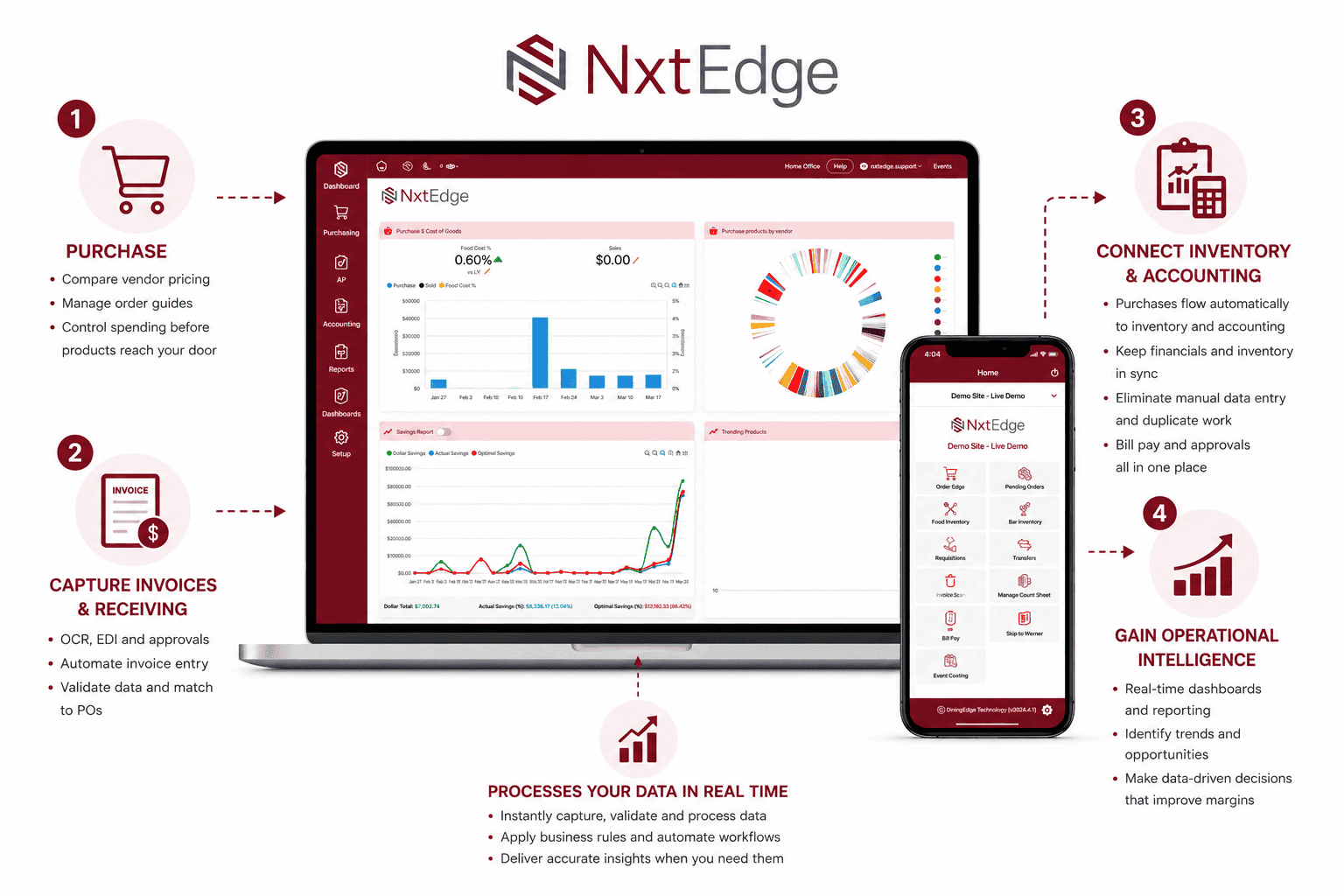
Hospitality organizations operate in one of the most challenging business environments in the world — rising food costs, labor shortages, vendor price fluctuations, and increasing financial oversight all make it difficult to maintain profitability while delivering exceptional guest experiences. Whether managing a restaurant group, country club, hotel, resort, senior living community, or multi-unit operation, leaders need visibility into purchasing, inventory, invoices, approvals, payments, and financial performance. NxtEdge connects purchasing, invoice automation, inventory, accounts payable, bill pay, accounting integration, and reporting into one hospitality-focused platform — so instead of gathering information from multiple systems, operators gain real-time visibility into the processes that impact profitability every day.
- Control purchasing before products reach your back door
- Automate invoice processing, approvals & bill pay
- Improve inventory accuracy & food cost visibility
- Connect operations & accounting in one platform
A Complete Guide to Hospitality Cost Control
Cost control has become one of the most important priorities in hospitality. Operators are expected to manage rising costs, labor challenges, changing guest expectations, and increasingly complex financial requirements while maintaining service standards and profitability.
At the same time, many organizations continue to rely on disconnected systems to manage purchasing, inventory, invoices, approvals, accounting, and reporting. Purchasing may occur through vendor websites. Invoices arrive through email. Inventory may be tracked in spreadsheets. Approvals often rely on manual processes. Accounting teams receive information after operational decisions have already been made.
The result is limited visibility and delayed decision making. Modern hospitality organizations require a different approach.
Modern hospitality organizations need:
- Systems that connect operational activity with financial information
- Visibility into purchasing before products arrive
- Automated invoice processing and approval workflows
- Inventory systems that connect to recipes, purchasing, and sales
- Accounting integration that reduces duplicate data entry
- One source of truth
This guide explores how hospitality organizations can modernize cost control by connecting purchasing, inventory, invoice automation, approvals, bill pay, accounting integration, and reporting into one platform.
By the end of this guide, you'll understand how leading hospitality operators are improving visibility, reducing administrative workload, strengthening financial controls, and creating a foundation for long-term profitability.
Why Hospitality Organizations Need More Than Inventory Software
For many years, hospitality organizations viewed inventory as the foundation of cost control. If inventory was counted accurately and food cost reports were produced on time, leadership believed they had sufficient visibility into operational performance.
Today, hospitality environments have become far more complex. A single organization may manage multiple locations, multiple departments, dozens of vendors, thousands of inventory items, and hundreds of invoices every month.
Each environment carries its own operational complexity:
- Hotels manage restaurants, bars, room service, and banquet operations
- Country clubs manage dining outlets, golf operations, pool facilities, and events
- Senior living communities manage dietary budgets and purchasing compliance
- Restaurant groups manage consistency across multiple locations
Each department generates purchasing activity, inventory movement, invoices, approvals, and financial transactions. When this information exists in separate systems, visibility becomes difficult.
Inventory software may show what products are on hand. Accounting software may show what was spent. Neither system alone explains why costs increased, where operational issues occurred, or how departments are performing in real time.
This is why hospitality organizations increasingly require more than inventory software. They require connected cost control platforms that link purchasing, invoices, inventory, approvals, payments, and accounting into one workflow. When information flows between departments automatically, organizations gain a clearer understanding of operational performance and financial results.
The real goal
The goal is not simply to count inventory. The goal is to create visibility.
When hospitality leaders can answer questions such as:
- Are we purchasing the right products?
- Are we paying competitive prices?
- Which invoices are awaiting approval?
- Which departments are overspending?
- How much inventory is currently on hand?
- What menu items are most profitable?
- What liabilities remain outstanding?
…they gain the ability to make better decisions before problems impact profitability. This shift from reactive management to proactive management represents the future of hospitality cost control.
Hospitality Cost Control Works Best When Everything Is Connected
One of the biggest challenges facing hospitality organizations today is that critical operational information exists in multiple systems. Purchasing is managed in one platform. Invoices arrive through email. Inventory is tracked somewhere else. Approvals happen through manual workflows. Accounting receives information after transactions have already occurred.
Each process may function independently, but together they create blind spots that make decision-making more difficult. Hospitality leaders need visibility into the entire operational lifecycle. They need to understand:
- What was purchased
- What was received
- What was consumed
- What was approved
- What was paid
- How costs impacted profitability
When this information is disconnected, operators spend valuable time gathering data rather than acting on it.
NxtEdge was designed around a simple concept: one connected platform. Purchasing, inventory, invoice automation, approvals, bill pay, accounting integration, recipe costing, and reporting work together to create a complete picture of operational performance. This allows organizations to move from reactive management to proactive decision making — instead of searching for answers, teams gain visibility into the information they need every day.
Benefits of a Connected Platform
Organizations that connect operational workflows often gain:
- Better visibility
- Reduced administrative effort
- Faster approvals
- More accurate reporting
- Better purchasing decisions
- Improved inventory controls
- Stronger accountability
- Better financial oversight
Confidence in your numbers
Most importantly, leadership gains confidence in the information used to make decisions.
Chapter 1
Purchasing & Vendor Price Comparison
Many hospitality organizations focus on controlling costs after products arrive. They review invoices. They count inventory. They analyze food cost reports. While these activities remain important, one of the greatest opportunities for savings often exists before products are purchased.
Every purchasing decision impacts profitability — the products selected, the vendors used, the quantities ordered, and the timing of purchases all influence operational costs. Unfortunately, many operators lack visibility into vendor pricing and purchasing activity. Orders are placed through multiple vendor websites. Managers purchase products independently. Price changes often go unnoticed. Alternative purchasing opportunities are missed. Over time, these inefficiencies create significant financial impact.
NxtEdge helps hospitality organizations gain greater visibility into purchasing activity through vendor price comparison and centralized purchasing workflows. Instead of relying on assumptions, operators gain access to information that supports better purchasing decisions.
Vendor price comparison
One of the most valuable purchasing tools available to hospitality organizations is vendor price comparison. Many organizations work with multiple vendors that offer similar products. Without visibility into pricing differences, it becomes difficult to determine whether purchases are being made at the best available cost. NxtEdge helps organizations compare product pricing, pack sizes, vendor options, historical costs, and approved products — visibility that helps operators identify opportunities for savings while maintaining purchasing consistency.
Purchasing controls
Strong purchasing controls help organizations maintain consistency across locations and departments. These controls may include approved products, approved vendors, purchasing permissions, department budgets, and spending visibility. When purchasing processes become standardized, organizations often improve both accountability and cost control.
Multi-location purchasing
Multi-unit organizations face additional purchasing challenges. Each location may use different products, pay different prices, and follow different ordering procedures. NxtEdge helps create visibility across locations while supporting operational consistency, allowing leadership teams to understand spending trends and purchasing performance across the organization.
Benefits
- Compare vendor pricing before orders are placed
- Establish approved products, vendors, and spending controls
- Standardize ordering across locations and departments
- Surface savings opportunities and alternative products
- Understand spending trends across multiple units
- Maintain centralized control with departmental accountability
See how hospitality organizations improve purchasing visibility and identify savings opportunities with NxtEdge Vendor Price Comparison and Purchasing Management.
Chapter 2
Invoice Automation & Processing
Invoices are one of the most important documents within hospitality operations. Every invoice contains valuable information about spending, product costs, vendor activity, inventory valuation, and financial obligations.
Unfortunately, invoice processing remains one of the most manual activities within many organizations. Invoices arrive through email. Paper invoices require filing. Data is manually entered. Coding consumes administrative time. Errors create delays. Approvals slow down payment processes. These manual workflows increase labor costs while limiting visibility.
NxtEdge helps automate invoice processing so organizations can spend less time entering data and more time managing operations.
OCR invoice processing
Optical Character Recognition (OCR) technology allows invoices to be processed automatically. Instead of manually entering information from vendor invoices, the system captures vendor name, invoice number, invoice date, product information, quantities, pricing, and totals — reducing administrative workload while improving accuracy.
Hospitality-specific invoice complexity
Hospitality invoices often contain complexities that traditional accounting systems struggle to manage — catch-weight products, variable pricing, multiple units of measure, beverage invoices, food invoices, and non-inventory invoices. NxtEdge was designed specifically for hospitality environments where invoice detail matters.
Better visibility through automation
Invoice automation provides more than efficiency — it creates visibility. Organizations gain access to information faster and with greater accuracy. Management teams can see outstanding invoices, spending trends, vendor activity, product costs, and approval status, supporting better decision making throughout the organization.
Benefits
- Eliminate manual invoice data entry
- Capture full line-item detail with OCR
- Support catch-weight and variable pack-size products
- See outstanding invoices and approval status at a glance
- Speed up processing and approvals
- Improve accuracy and spending visibility
See how hospitality organizations automate invoice processing, reduce manual entry, and improve operational visibility.
Chapter 3
Accounts Payable Automation & Approval Workflows
For many hospitality organizations, the most difficult part of accounts payable is not entering invoices — it is managing approvals. Invoices move between departments. Managers become busy. Approvals are delayed. Accounting teams spend time following up rather than processing payments.
Without visibility into approval workflows, organizations often struggle to answer basic questions: Which invoices are awaiting approval? Who is responsible for approving them? How long have they been pending? Have any invoices been missed? As invoice volumes increase, manual approval processes become increasingly difficult to manage.
NxtEdge helps automate approval workflows while maintaining accountability throughout the organization. Instead of relying on email chains, paper copies, or verbal communication, invoices move through structured approval processes that provide visibility at every stage.
Multi-level approvals
Many hospitality organizations require multiple approval levels — for example, department manager, then food & beverage director, then controller, then payment processing. NxtEdge supports approval workflows that help organizations maintain internal controls while reducing administrative effort.
Mobile approvals
Hospitality leaders rarely spend their day sitting behind a desk. General managers walk properties. Chefs manage kitchens. Directors oversee operations. NxtEdge allows invoices to be reviewed and approved remotely, helping organizations keep workflows moving without delays.
Visibility creates accountability
When organizations can see where invoices are within the approval process, accountability improves. Instead of asking where an invoice is located, teams gain immediate visibility into approval status, pending approvals, historical approvals, user activity, and outstanding actions — reducing confusion while improving operational efficiency.
Benefits
- Route invoices through structured, multi-level approvals
- Review and approve invoices remotely from any device
- See approval status and pending actions in real time
- Maintain a complete approval audit trail
- Reduce time spent chasing approvals
- Strengthen financial controls and audit readiness
See how NxtEdge helps hospitality organizations automate invoice approvals and create stronger AP workflows.
Chapter 4
Bill Pay
Managing payments is one of the most important responsibilities within hospitality finance. Organizations may process hundreds or thousands of invoices each month, and each invoice requires verification, approval, payment, and reconciliation.
Traditional payment processes often involve multiple systems and significant manual effort. Invoices are approved in one place. Payments are issued somewhere else. Accounting records are updated separately. This fragmented process creates inefficiencies while limiting visibility. NxtEdge helps streamline bill pay by connecting payment workflows to invoice approvals and financial processes — the result is greater visibility, improved control, and less administrative effort.
Visibility into payment status
One of the biggest challenges organizations face is understanding where invoices are within the payment lifecycle: Has the invoice been approved? Has payment been issued? Has the vendor been paid? When was payment processed? NxtEdge provides visibility throughout the payment process so organizations can answer these questions quickly.
Payment flexibility
Hospitality organizations often work with vendors that have different payment preferences — ACH payments, check payments, virtual cards, and electronic payments. Flexible payment options help organizations maintain strong vendor relationships while improving operational efficiency.
Improving vendor relationships
Timely payments support stronger vendor partnerships. When vendors are paid accurately and on time, organizations often experience better service, improved communication, stronger partnerships, and better purchasing opportunities. Bill pay automation helps create a more consistent payment experience for both vendors and operators.
Benefits
- Move seamlessly from approval to payment
- Pay via ACH, check, virtual card, or electronic payment
- Track payment status across the full lifecycle
- Maintain a complete payment audit trail
- Strengthen vendor relationships with on-time payments
- Reduce manual effort and payment delays
See how NxtEdge helps hospitality organizations streamline vendor payments and connect bill pay to accounting.
Chapter 5
Accounting Integration & Financial Connectivity
One of the most common frustrations within hospitality organizations is duplicate data entry. Operational teams manage purchasing, inventory, invoices, and approvals. Accounting teams manage financial reporting. Unfortunately, these activities often occur in separate systems — the result is duplicated work, delayed reporting, and reduced visibility.
NxtEdge helps bridge the gap between operations and accounting. Rather than forcing teams to re-enter information manually, operational data can flow into accounting workflows more efficiently, improving both productivity and visibility.
Why accounting integration matters
Accounting systems provide valuable financial reporting, but they are not designed to manage day-to-day hospitality operations. They typically answer questions such as what was spent, what was paid, and what liabilities remain outstanding. Operational teams need answers to different questions: What products were purchased? Which vendors increased pricing? Which departments are overspending? What inventory was consumed? By connecting operational data with accounting systems, organizations gain a more complete understanding of performance.
Reducing duplicate entry
One of the primary goals of accounting integration is reducing duplicate work. Instead of entering information multiple times, organizations can streamline workflows while maintaining accuracy — reducing labor, fewer errors, faster reporting, and better consistency. This allows accounting teams to focus on analysis rather than data entry.
Departmental visibility & month-end reporting
Hospitality organizations frequently require visibility by department, outlet, property, region, and business unit. Accounting integration helps support these reporting requirements while maintaining financial consistency. Month-end processes place significant demands on accounting teams — data must be collected, invoices reviewed, transactions reconciled, and reports prepared. When operational and accounting systems are connected, organizations reduce manual effort while improving reporting speed and accuracy, so operators and accountants begin working from a single source of truth.
Benefits
- Eliminate duplicate data entry
- Give operators and accountants one source of truth
- Support departmental, outlet, and multi-property reporting
- Speed up and improve the month-end close
- Improve accuracy and financial controls
- Connect operational decisions to financial outcomes
See how NxtEdge connects purchasing, invoices, approvals, payments, and accounting into one workflow.
Chapter 6
Inventory Control & Cost Visibility
Many hospitality organizations view inventory as a monthly accounting exercise. Products are counted. Reports are generated. Food cost is calculated. While these activities remain important, modern inventory management provides much greater value.
Inventory represents one of the largest controllable assets within hospitality operations. Understanding what is on hand, what is being consumed, and how inventory impacts profitability is essential to effective cost control. NxtEdge helps organizations transform inventory from a reporting exercise into a strategic management tool.
Food & beverage inventory
Food inventory impacts every hospitality operation — restaurants, hotels, country clubs, and senior living communities all depend on accurate food inventory information to manage costs and maintain profitability. Inventory visibility helps operators reduce waste, improve purchasing, understand food cost, identify variances, and improve forecasting. Beverage programs often present unique challenges — liquor, wine, beer, mixers, beverage carts, and banquet bars — and NxtEdge helps organizations maintain visibility into beverage inventory while improving accountability.
Mobile inventory counting
Manual inventory processes consume valuable time. Mobile counting allows teams to complete inventories more efficiently while reducing paperwork and data entry — delivering faster counts, improved accuracy, better user adoption, and reduced administrative effort.
Inventory variance analysis
Variances occur when actual inventory differs from expected inventory. Common causes include waste, over-portioning, theft, receiving errors, transfer errors, and recipe inconsistencies. Variance analysis helps organizations identify issues before they significantly impact profitability. When organizations understand what inventory is available, what is moving, and what is being consumed, they can make better purchasing, production, and operational decisions.
Benefits
- Manage food and beverage inventory in one place
- Count faster with mobile inventory workflows
- Keep inventory valuations accurate and current
- Use variance analysis to find cost drivers
- Reduce waste, spoilage, and over-purchasing
- Connect inventory to purchasing, invoices, and recipes
See how NxtEdge helps hospitality organizations improve inventory accuracy and strengthen food cost control.
Chapter 7
Recipe Costing, Menu Analysis & Profitability
Many hospitality operators know their sales numbers. Far fewer know the true profitability of the products they sell. A menu item may be popular, generate significant revenue, and even be one of the best-selling items on the menu — yet still be one of the least profitable items in the operation.
Without recipe costing and menu analysis, organizations often make decisions based on assumptions rather than data. NxtEdge helps hospitality organizations understand exactly how ingredient costs, purchasing activity, and menu pricing impact profitability. Rather than relying on spreadsheets and periodic reviews, operators gain visibility into menu performance using current operational information.
Why recipe costing matters
Every menu item carries costs — ingredients, prep labor, waste, portioning, and vendor price changes. When organizations fail to track these costs accurately, margins can erode quickly. Recipe costing helps answer questions such as: What does this item actually cost? Have ingredient costs increased? Is pricing still appropriate? Which items contribute the most profit, and which require adjustment? These insights help operators make informed decisions that improve profitability.
Menu engineering & contribution margin
Many operators focus only on food cost percentage, but food cost percentage alone does not tell the complete story. Menu engineering evaluates both popularity and profitability, allowing operators to identify high-profit menu items, underperforming items, pricing opportunities, and promotion opportunities. Contribution margin analysis helps determine which menu items generate the greatest financial return.
Event & banquet costing
Hotels, country clubs, event venues, and catering operations frequently depend on banquet and event revenue. Understanding event profitability requires visibility into ingredient costs, purchasing requirements, guest counts, and menu selections. NxtEdge helps operators evaluate costs before events take place so pricing decisions can be made with greater confidence.
Beverage costing
Food cost is only one part of hospitality profitability. Beverage programs often represent a significant revenue source, and understanding beverage costs requires visibility into inventory, recipes, purchasing, and consumption. This information helps organizations manage beverage profitability more effectively.
Benefits
- Better menu visibility
- Improved pricing decisions
- Stronger profitability analysis
- Better event and banquet costing
- Reduced waste
- Greater consistency across menu items
See how NxtEdge helps hospitality operators understand the true profitability of every menu item.
Chapter 8
POS Integration & Theoretical Food Cost
Sales data provides some of the most valuable information within hospitality operations. Every transaction reveals what guests purchased, when products were sold, and how menus are performing. However, sales information becomes significantly more valuable when connected to inventory, recipes, and purchasing data. NxtEdge helps organizations connect POS data to broader cost control workflows, creating greater visibility into operational performance and profitability.
What is theoretical food cost?
Theoretical food cost represents what food cost should be based on sales and recipe information, while actual food cost reflects what was actually consumed. Comparing these two numbers creates valuable operational insight. When actual food cost exceeds theoretical food cost, organizations can investigate potential causes such as waste, theft, portioning issues, receiving errors, and inventory inaccuracies. This comparison helps operators identify opportunities for improvement.
Menu mix analysis
Not all menu items contribute equally to profitability. POS integration helps organizations understand sales volume, product popularity, revenue contribution, and profitability — information that supports menu engineering and strategic decision making.
Consumption visibility
When POS sales data connects to recipes and inventory, organizations gain a clearer understanding of product consumption. This visibility supports purchasing, forecasting, inventory planning, and cost analysis. Rather than relying on estimates, operators gain data-driven insight into operational performance.
Benefits
- Better food cost visibility
- Improved reporting
- Stronger forecasting
- Better inventory planning
- More accurate profitability analysis
See how NxtEdge connects POS sales data to inventory, recipes, and purchasing for complete food cost visibility.
Chapter 9
Transfers & Requisitions
Hospitality organizations rarely operate from a single location. Hotels manage restaurants, bars, banquet facilities, room service, and storage locations. Country clubs manage dining rooms, golf operations, beverage carts, and pool facilities. Multi-unit organizations manage inventory across multiple properties. Products constantly move throughout the operation, and without visibility into these movements, inventory accuracy becomes difficult to maintain. NxtEdge helps organizations track transfers and requisitions so inventory remains visible regardless of where it moves.
Why transfers matter
Inventory does not simply arrive and remain in one location. Products are frequently moved between departments — main kitchen to banquet operations, central storage to restaurant outlets, main bar to pool bar, or warehouse to multiple locations. Without documentation, inventory visibility decreases and accountability becomes more difficult. Transfers help maintain accurate records throughout the organization.
Requisitions create accountability
Many organizations use centralized purchasing and inventory management, with departments requesting products when needed. Without formal requisition processes, these requests often occur through phone calls, emails, text messages, or verbal communication. NxtEdge helps create structured requisition workflows that improve visibility and accountability, giving organizations insight into who requested products, when inventory was issued, and which departments received it.
Multi-department operations
Hospitality environments often include multiple inventory-consuming departments — restaurants, bars, banquets, golf operations, pool operations, catering, and room service. Transfers and requisitions help maintain visibility across these areas while improving operational control.
Reducing over-ordering
Organizations frequently purchase products that already exist elsewhere within the operation. When inventory movement becomes visible, teams can utilize existing inventory before purchasing additional products, helping reduce excess inventory, carrying costs, waste, and over-ordering.
Benefits
- Improved inventory accuracy
- Better accountability
- Stronger cost allocation
- Reduced discrepancies
- Better visibility into inventory movement
See how NxtEdge keeps inventory visible and accountable as it moves across every department and location.
Case Studies
Tedesco Country Club
Challenge
Improve inventory visibility and establish stronger food and beverage controls.
Solution
Inventory management, transfers, requisitions, and operational reporting.
Results
- Greater accountability and a foundation for long-term cost control success.
Ventura Health Services
Challenge
Manage food purchasing, budgets, and reporting across multiple facilities.
Solution
Vendor price comparison, purchasing visibility, invoice management, and standardized workflows.
Results
- Improved consistency, visibility, and budget management across facilities.
Gotti's
Challenge
Improve operational visibility while supporting growth.
Solution
NxtEdge implementation with purchasing, inventory, and reporting workflows.
Results
- Greater operational insight and improved decision making.
Oriente Beach Club
Challenge
Improve beverage cost performance.
Solution
Inventory visibility and beverage cost management.
Results
- Improved beverage profitability and stronger operational controls.
Common Outcomes
Results
- Visibility
- Accountability
- Purchasing controls
- Inventory accuracy
- AP efficiency
- Financial reporting
Most importantly, operators gain the information necessary to make better decisions.
Every Hospitality Segment Faces Unique Cost Control Challenges
While all hospitality organizations share common goals such as controlling costs, improving profitability, and maintaining service quality, each segment faces unique operational challenges. Understanding these challenges is essential when selecting technology and building operational workflows.
Country Clubs
Country clubs operate some of the most complex food and beverage environments in hospitality. A single property may include:
- Multiple dining outlets
- Banquet operations
- Golf facilities
- Beverage carts
- Pool operations
- Tennis facilities
- Private events
Inventory moves constantly between departments. Member expectations remain high. Events create additional purchasing complexity. Country clubs require visibility across multiple outlets while maintaining accountability and operational consistency.
Hotels & Resorts
Hotels often operate multiple revenue centers simultaneously. Examples include:
- Restaurants
- Bars
- Room service
- Banquets
- Catering
- Retail operations
Each area generates purchasing activity, invoices, inventory consumption, and financial transactions. Without connected systems, visibility becomes difficult. Hotels require strong accounting integration, AP automation, and operational reporting to maintain control across the property.
Restaurants
Restaurants face some of the tightest margins in hospitality. Success depends on controlling:
- Food cost
- Labor cost
- Purchasing
- Waste
- Menu profitability
Small operational inefficiencies can significantly impact profitability. Restaurant operators require fast access to information that supports daily decision making.
Senior Living
Senior living communities face unique challenges related to:
- Budget management
- PPD (Per Patient Day) reporting
- Dietary compliance
- Standardization
- Multi-facility oversight
Leaders require visibility into both spending and operational performance across multiple communities.
Multi-Unit Operations
Organizations operating multiple locations require visibility at both the location and enterprise level. Leadership needs answers to questions such as:
- Which locations are performing best?
- Which vendors are driving spending?
- Where are costs increasing?
- Which locations require attention?
Connected reporting becomes critical for effective multi-unit management.
Cost Control Begins Before Products Arrive
Many organizations focus on cost control after purchases are made. They review invoices. They analyze reports. They count inventory. While these activities remain important, the purchasing process represents the earliest opportunity to influence costs.
Every purchasing decision impacts profitability. The products selected. The vendors used. The quantities ordered. The timing of purchases. These decisions determine how much money leaves the organization before products ever reach the property.
Purchasing Drives Financial Performance
Consider a simple example. If a property spends $2 million annually on food and beverage purchases, a modest 5% improvement in purchasing efficiency could generate $100,000 in annual savings. These opportunities often go unnoticed because organizations lack visibility into pricing and purchasing activity.
Visibility Before the Order Is Placed
Traditional cost control focuses on reviewing costs after the fact. Modern cost control focuses on visibility before purchases occur. Vendor price comparison, approved products, purchasing controls, and budgeting help organizations make better decisions before spending occurs. This proactive approach creates stronger financial outcomes.
Purchasing Controls Reduce Risk
Strong purchasing controls help organizations:
- Reduce unauthorized purchases
- Improve standardization
- Maintain approved vendor relationships
- Improve budgeting
- Increase accountability
When purchasing becomes visible, leadership gains greater confidence in operational spending.
The Foundation of Cost Control
Purchasing influences inventory, food cost, vendor relationships, cash flow, and profitability. This is why purchasing remains one of the most important components of effective hospitality cost control.
Manual Accounts Payable Processes Can No Longer Keep Up
Accounts payable departments face increasing pressure to do more with fewer resources. Invoice volumes continue to rise. Approval requirements continue to expand. Financial oversight expectations continue to increase.
Unfortunately, many hospitality organizations still rely on manual AP processes. Invoices are entered manually. Approvals are routed through email. Accounting teams spend hours tracking down missing information. These inefficiencies create delays and increase administrative costs.
The Hidden Cost of Manual AP
Manual AP processes often create costs that are difficult to measure. Examples include:
- Data entry labor
- Approval delays
- Lost invoices
- Duplicate payments
- Reporting delays
- Audit preparation
While these costs may not appear directly on financial statements, they consume valuable organizational resources.
Automation Improves Visibility
AP automation provides more than efficiency. It provides visibility. Organizations gain insight into:
- Outstanding invoices
- Approval status
- Payment schedules
- Spending activity
- Vendor balances
This visibility supports stronger decision making while reducing administrative effort.
Better Controls for Growing Organizations
As organizations grow, approval requirements become more complex. AP automation helps establish consistent processes while maintaining financial controls. This becomes especially important for:
- Hotels
- Multi-unit operations
- Healthcare organizations
- Country clubs
The Future of Hospitality Finance
Modern hospitality finance departments require tools that connect operational activity with financial workflows. AP automation plays a critical role in achieving this objective. Organizations implementing AP automation often gain:
- Faster processing
- Better controls
- Greater visibility
- Improved reporting
- Reduced labor
Most importantly, finance teams gain more time to focus on strategic initiatives rather than administrative tasks.
Inventory Is Important, But It Doesn't Tell the Whole Story
For years, food cost management centered around inventory counts. Beginning inventory. Purchases. Ending inventory. Food cost. While this calculation remains valuable, it provides only a partial view of operational performance.
Inventory reports explain what happened. They rarely explain why it happened.
Food Cost Is Influenced by Many Factors
Inventory represents only one component of food cost. Other factors include:
- Purchasing decisions
- Vendor pricing
- Waste
- Portioning
- Recipe management
- Menu mix
- Sales volume
- Transfers
Without visibility into these areas, organizations may struggle to identify the true drivers of food cost.
Connected Systems Create Better Visibility
When inventory connects to purchasing, invoices, recipes, POS data, and reporting, organizations gain a much more complete understanding of operational performance. Instead of simply reviewing food cost reports, operators can identify opportunities for improvement.
Understanding Variances
One of the most valuable uses of connected data is variance analysis. Comparing expected consumption against actual consumption helps identify:
- Waste
- Theft
- Over-portioning
- Process issues
This visibility helps organizations take corrective action before costs escalate.
Food Cost Requires Context
Inventory remains important. However, inventory alone cannot explain every change in food cost performance. The future of hospitality cost control lies in connecting inventory with the operational data that drives it. This broader perspective helps operators make better decisions and improve profitability.
Spreadsheets Were Built To Store Information, Not Manage Hospitality Operations
For decades, spreadsheets have been the default tool for managing hospitality data — purchasing logs, inventory counts, food cost calculations, budget tracking, vendor comparisons, and operational reporting.
Spreadsheets became popular because they were accessible, flexible, and inexpensive. However, as hospitality operations have grown more complex, spreadsheets have become increasingly difficult to manage. Today's organizations require visibility, automation, collaboration, and real-time information — capabilities spreadsheets were never designed to provide.
The Hidden Costs of Spreadsheet Management
Most operators underestimate how much time their teams spend maintaining spreadsheets:
- Managers manually update reports
- Accounting teams reconcile data
- Inventory counts are entered by hand
- Version control becomes a constant challenge
These activities create hidden labor costs that often go unnoticed. The issue is not the spreadsheet itself — it is the time required to maintain it.
Version Control Challenges
One of the most common spreadsheet problems involves multiple versions of the same document. Questions often include:
- Which version is correct?
- Who updated the file?
- When was it changed?
- Which numbers should we trust?
When organizations rely on spreadsheets, maintaining consistency becomes increasingly difficult.
Reporting Delays
Leadership teams require timely information. Unfortunately, spreadsheets often create delays because information must be manually collected and consolidated before reports can be generated. By the time reports are completed, operational conditions may have already changed. Connected systems help eliminate these delays by making information available in real time.
Moving Beyond Manual Processes
The goal is not simply to eliminate spreadsheets. The goal is to reduce the manual effort required to manage information. Organizations that automate workflows often gain:
- Better visibility
- Faster reporting
- Greater accuracy
- Reduced labor
- Better decision making
The future of hospitality management depends on connected systems rather than disconnected spreadsheets.
Proven Strategies for Improving Hospitality Profitability
Technology plays an important role in cost control, but technology alone does not create results. Successful hospitality organizations combine technology with operational best practices.
The following practices help create stronger financial performance while improving visibility and accountability.
Conduct Regular Inventory Counts
Inventory provides critical information regarding:
- Product usage
- Food cost
- Beverage cost
- Inventory valuation
Organizations that maintain consistent inventory routines often gain greater operational visibility. Many operators perform inventory weekly, bi-weekly, or monthly, depending on operational requirements.
Review Vendor Pricing Regularly
Vendor pricing changes frequently. Organizations that compare pricing regularly often identify opportunities for savings. Vendor reviews should include:
- Price comparisons
- Product substitutions
- Purchasing trends
- Vendor performance
Even small improvements can create meaningful financial impact over time.
Automate Invoice Processing
Manual invoice entry consumes valuable time. Invoice automation helps reduce:
- Data entry
- Processing delays
- Errors
- Administrative effort
Organizations gain visibility faster while improving operational efficiency.
Establish Approval Workflows
Approval workflows help ensure accountability. Clearly defined approval processes improve visibility while reducing confusion regarding responsibilities. Strong approval workflows help organizations maintain financial controls while accelerating operational processes.
Review Menu Profitability
Menu performance should be reviewed regularly. Organizations should evaluate:
- Food cost
- Contribution margin
- Menu popularity
- Pricing
These insights help support informed menu decisions.
Monitor Reporting Consistently
Reporting provides visibility into:
- Spending
- Inventory
- Vendor activity
- Operational performance
Organizations that review reports consistently often identify opportunities before they become significant problems.
Questions Every Hospitality Operator Should Ask Before Selecting Software
Technology investments impact operations for years. Selecting the right platform requires careful evaluation. The following questions can help hospitality organizations make informed decisions.
Does the Platform Support Hospitality?
Many software products were originally designed for other industries. Hospitality organizations should evaluate whether the platform supports:
- Food & Beverage operations
- Inventory management
- Purchasing workflows
- AP automation
- Hospitality reporting
Does It Connect Operational Workflows?
Organizations should evaluate whether the platform connects:
- Purchasing
- Invoices
- Approvals
- Payments
- Accounting
- Inventory
Connected systems typically provide greater visibility than standalone solutions.
Does It Reduce Administrative Work?
Technology should reduce manual effort. Organizations should evaluate whether the platform automates:
- Invoice entry
- Approval routing
- Reporting
- Data transfers
Reducing administrative workload often creates significant value.
Does It Scale?
As organizations grow, operational requirements become more complex. Software should support:
- Additional locations
- Additional users
- Additional workflows
- Future growth
Scalability protects technology investments.
Is Support Available?
Successful implementations depend on more than software. Organizations should evaluate:
- Training
- Customer support
- Onboarding resources
- Industry expertise
Long-term support often plays a significant role in implementation success.
Why Cost Control Matters More Than Ever
Hospitality organizations operate in an environment where small inefficiencies can create significant financial impact. Even modest improvements in purchasing, inventory management, AP automation, and operational visibility can produce substantial annual savings.
Food & Beverage Represents a Major Expense
Food and beverage purchases often represent one of the largest controllable expenses within hospitality operations. Managing these costs effectively requires visibility into:
- Purchasing
- Inventory
- Recipes
- Vendor pricing
- Consumption
Organizations that lack visibility often struggle to identify opportunities for improvement.
Manual Processes Create Hidden Costs
Manual processes impact labor, accuracy, reporting speed, and operational visibility. Many organizations underestimate the true cost of manual workflows because these costs are spread across multiple departments. Automation helps reduce this burden while improving visibility.
Reporting Drives Better Decisions
Organizations that have access to timely operational information often make better decisions. Visibility allows leaders to:
- Respond faster
- Identify trends
- Improve accountability
- Reduce waste
This is one of the primary reasons hospitality technology continues to evolve.
Small Improvements Create Large Results
Consider the potential impact of:
- A 3% purchasing improvement
- Faster invoice processing
- Reduced inventory variance
- Better menu profitability
Small operational improvements often compound over time and create meaningful financial results.
The Future of Hospitality Cost Control
The future belongs to organizations that can connect operational activity and financial information into one source of truth. Those organizations gain visibility that supports faster, smarter decision making.
Implementation, Training & Ongoing Support
Technology only creates value when teams use it. One of the biggest concerns hospitality organizations have when evaluating software is implementation — how long it will take, how much time it requires, who will train the team, what happens after go-live, and whether staff will actually use the system. At NxtEdge, implementation is viewed as a partnership rather than a software installation. The goal is not simply to launch a platform — it is to improve operational performance.
Every Hospitality Organization Is Different
No two hospitality organizations operate the same way. A hotel has different requirements than a country club, and a senior living community faces different challenges than a restaurant group. Because of this, implementations begin by understanding:
- Organizational structure
- Current workflows
- Vendor relationships
- Accounting requirements
- Reporting needs
- Operational goals
This information helps ensure the platform supports the way the organization actually operates.
Guided Onboarding
Most implementations follow a structured process that includes:
- Weekly meetings
- Defined milestones
- Training sessions
- Workflow reviews
- Progress evaluations
This phased approach helps organizations build confidence while maintaining momentum.
NxtEdge University
Customers gain access to training resources including:
- Video tutorials
- Help articles
- Workflow guides
- AI-powered assistance
- Product overviews
These resources help teams continue learning long after implementation is complete.
Long-Term Support
Support does not end after go-live. Hospitality organizations continue receiving:
- Technical support
- Customer success assistance
- Product updates
- Best practice guidance
- Additional training
The objective is to build long-term partnerships that help organizations continue improving over time.
Flexible Solutions — Build Your Edge
Every hospitality organization has different priorities. Some operators need better inventory controls, others struggle with invoice processing, and many are focused on approvals, bill pay, or accounting integration. NxtEdge was designed as a flexible platform rather than a one-size-fits-all solution — so organizations can start where they see the greatest opportunity and expand over time.
Start With Inventory
Many organizations begin with food inventory, beverage inventory, cost visibility, and mobile counting. This creates a strong foundation for future cost control initiatives.
Start With Purchasing
Organizations seeking immediate savings often begin with vendor price comparison, purchasing controls, product standardization, and spend visibility. Purchasing improvements can create measurable financial impact quickly.
Start With AP Automation
Accounting teams often prioritize invoice automation, approval workflows, AP visibility, and bill pay. These workflows reduce administrative effort while improving financial controls.
Build A Complete Platform
Over time, many organizations expand into inventory, purchasing, invoice automation, approvals, bill pay, accounting integration, recipe costing, and reporting — creating a fully connected hospitality cost control environment.
Technology That Grows With You
As organizations evolve, operational requirements change. NxtEdge provides a platform that can continue expanding alongside the business without requiring organizations to replace existing systems.
Trusted by Hospitality Operators
Technology decisions are ultimately built on trust. Organizations need confidence that their software provider understands hospitality operations and can support long-term success. NxtEdge works with restaurants, country clubs, hotels, senior living communities, healthcare organizations, and multi-unit operators across North America.
Built For Hospitality
Unlike generic business software, NxtEdge was designed specifically to support hospitality workflows, including:
- Food & Beverage Purchasing
- Vendor Price Comparison
- Inventory Management
- Invoice Automation
- Bill Pay
- Accounting Integration
- Recipe Costing
- Operational Reporting
This hospitality focus allows organizations to improve efficiency without changing the way they operate.
Supporting Multiple Stakeholders
NxtEdge provides value for:
- General Managers
- Controllers
- Executive Chefs
- Food & Beverage Directors
- Purchasing Managers
- Accounting Teams
Each group gains visibility into the information most relevant to their responsibilities.
Customer Success Stories
Organizations use NxtEdge to improve:
- Purchasing visibility
- AP efficiency
- Inventory accuracy
- Food cost management
- Reporting
- Financial visibility
Customer stories throughout this guide demonstrate how connected workflows can improve operational performance.
Unlike generic business software, NxtEdge was designed specifically to support hospitality workflows — so organizations can improve efficiency without changing the way they operate.
Frequently Asked Questions
General Questions
Purchasing Questions
Invoice Automation Questions
AP Automation Questions
Bill Pay Questions
Inventory Questions
Accounting Questions
Implementation Questions
Related Resources
Industry Guides
Solution Pages
Customer Stories
Learning Hub Resources
Hospitality Cost Control Software: Summary
Hospitality organizations face increasing pressure to improve profitability while maintaining exceptional guest experiences. Success requires more than spreadsheets and disconnected systems — it requires visibility, accountability, and connected workflows that bring purchasing, inventory, invoice automation, approvals, bill pay, accounting integration, recipe costing, and reporting together into one platform.
NxtEdge helps hospitality operators gain control over the processes that impact profitability every day. Whether the goal is reducing food cost, improving purchasing visibility, automating accounts payable, strengthening financial controls, or improving operational reporting, NxtEdge provides a hospitality-focused solution designed to support long-term success.
Why Hospitality Organizations Choose NxtEdge
- Hospitality Cost Control Software
- Hospitality Purchasing Software
- Hospitality Inventory Software
- Hospitality Invoice Automation Software
- Hospitality AP Automation Software
- Hospitality Bill Pay Software
- Hospitality Accounting Integration Software
- Hospitality Reporting Software
Ready To Gain Control Over Hospitality Costs?
Today's hospitality organizations need more than spreadsheets and disconnected systems. They need visibility, accountability, and connected workflows that bring purchasing, inventory, invoice automation, approvals, bill pay, accounting integration, recipe costing, and reporting together into one platform. See how NxtEdge helps hospitality operators connect operations and accounting — and improve the processes that impact profitability every day.